Presumptive Eligibility: The Fast Pass to Medicaid Coverage
Presumptive eligibility (PE) is a process through which people can access immediate, temporary Medicaid coverage for certain care. Since the passage of the Affordable Care Act (ACA), all states have had to implement hospital presumptive eligibility, but they have the option to expand PE programs so pregnant people, children, and folks who need family planning and related services can access immediate, temporary coverage at other sites, like federally qualified health centers (FQHCs), sexual and reproductive health (SRH) clinics, or other community sites that serve children and families.
PE allows patients to go to a qualified provider and self-attest to their income, whether they’re pregnant and, depending on the state, their residency and immigration or citizenship status. The provider then uses that information to determine whether the patient appears to be eligible for Medicaid coverage. If the patient is presumed eligible then they can receive Medicaid coverage for their visit that very day and the coverage lasts 30–60 days—either until the last day of the month following their PE application, or until a final determination is made on the patient’s full Medicaid application.
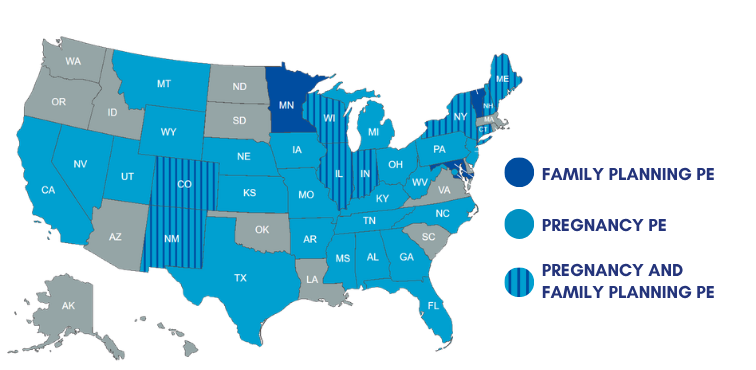
As of September 2026, 33 states offer PE for pregnant people, allowing pregnant people to immediately access coverage for prenatal care. This number has grown in recent years with Mississippi, Alabama, and Arkansas each recognizing the importance of timely access to care improving maternal and infant health outcomes and expanding PE to pregnant people in 2024 and 2025.
However, PE for family planning remains underutilized. Among the 34 states with Medicaid Family Planning Programs (MFPPs) that expand coverage for family planning and related services to people with incomes too high to qualify for full Medicaid benefits, only 12 have adopted PE. Family planning PE can help patients to access timely contraceptive and STI care and other family planning and related services, reducing unintended or mistimed pregnancies and preventing sexual health conditions from worsening.
Further, PE promotes health center sustainability by providing a pathway to convert uninsured patients to insured patients without delaying the patient’s care. Services provided during a patient’s PE period are still covered and paid for even if the patient turns out not to be eligible for Medicaid coverage.
Implementation of work requirements and more frequent redeterminations for the Medicaid Expansion population means that patients may arrive for their appointments and not realize they’ve become uninsured. Family planning PE provides a pathway for these patients to immediately receive partial coverage, reducing the financial impact on the patient and provider and ensuring the patient does not have to forego or delay their birth control, STI testing and treatment, or important cancer screening.
Your state can adopt family planning PE by amending their MFPP State Plan Amendment (SPA), 1115 waiver, or state-funded program. States have the flexibility to choose whether to ask PE applicants about their state residency and citizenship or immigration status as part of the PE application and can choose how often an applicant can get PE coverage. Illinois and Connecticut both offer Family Planning PE twice per year. Services provided under PE are matched by the federal government, making this a fiscally prudent way for states to offer coverage and maximize federal support.
Click the image below to read and download ICAN!’s resource on presumptive eligibility.
 Handout Presumptive Eligibility
Connect with us!
icancoverall.org